Industries7 min read
AI chatbots for healthcare: 5 fundamentals to nail first
Chatwize teamPublished on
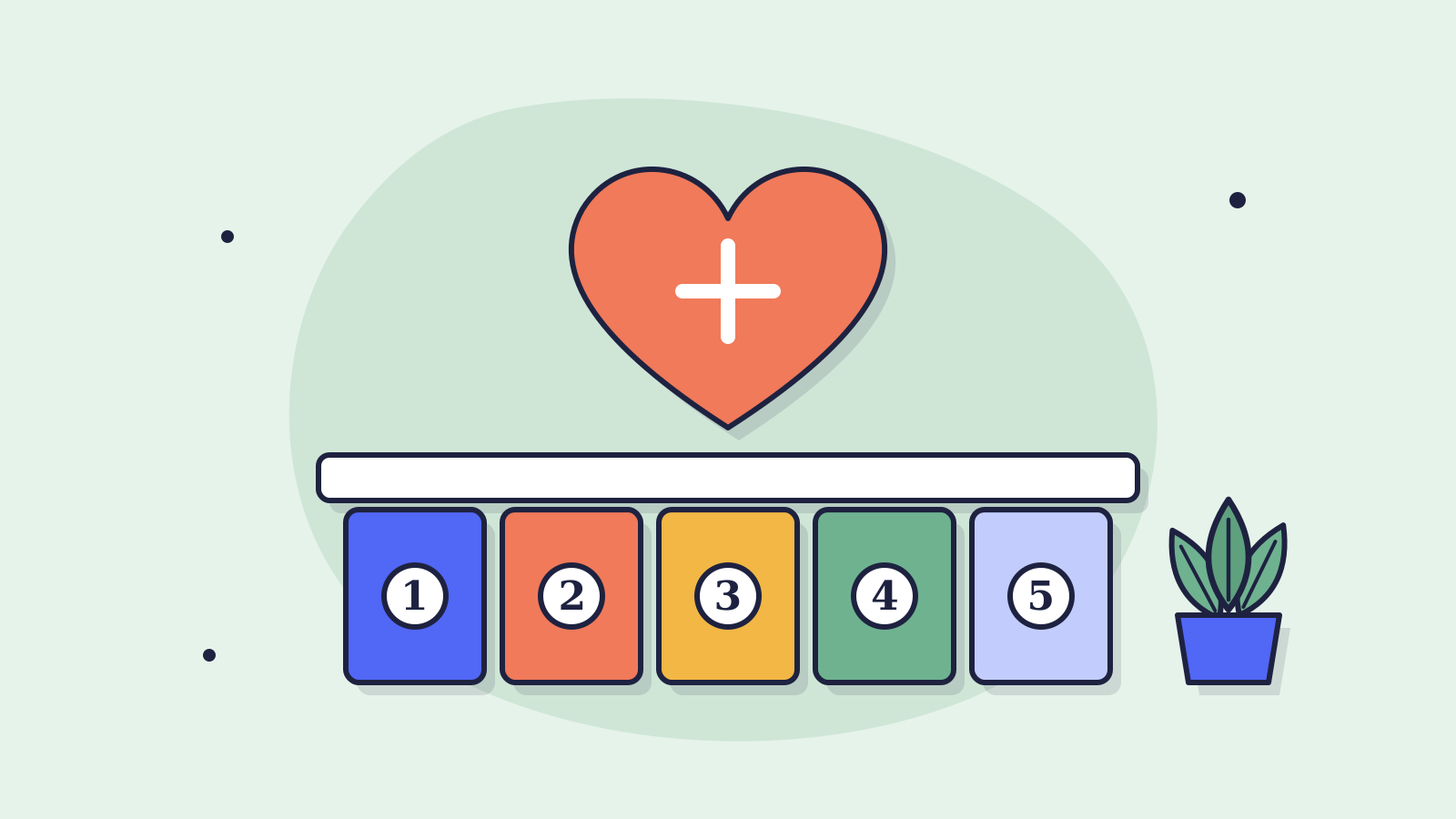
An AI chatbot for healthcare sounds simple, until you start. Privacy, escalation, language, urgency and tone are each a hurdle on their own, and together they're the difference between a tool that genuinely helps patients and an expensive liability. These are the five fundamentals to nail before go-live.
1. GDPR, hosting and data processing
Patient data is special-category personal data. Where it's processed, how it's encrypted, and whether it's used to train external models, you need that in writing. Not as opinion, as legal fact. It's not a question of “must stay in the EU” (GDPR explicitly recognises legitimate cross-border transfers via SCCs and the EU-US Data Privacy Framework), it's a question of transparent, certified infrastructure with a chain you can prove.
Five questions to ask any chatbot vendor
- Where are the servers and in which region? Push until you get the actual provider and data centre, not just 'the EU'.
- What technical and organisational measures are documented? Encryption at rest and in transit, strict per-customer separation, and a documented backup schedule.
- Is there a Data Processing Agreement (DPA) that also covers sub-processors?
- For hosting outside the EU: are Standard Contractual Clauses in place, or does it fall under the EU-US Data Privacy Framework?
- Is your data used to train external models, and is the opt-out in the contract?
Common pitfall
Assuming that “EU-hosted” is the only criterion. US hosting with a tight DPA and SCCs can be a valid basis, EU hosting without those documents is not.
2. Escalation paths
The question isn't whether the bot will hit something it can't handle, it's when. Before launch, define: which topics escalate immediately (acute medical, suicide signals, palliative), to whom (triage nurse, GP, after-hours service), and with what response time? Write it down. Test it.
- Direct hand-off with phone number and clear instruction for acute issues
- Quiet escalation to the right team member for non-urgent care questions
- Out-of-office behaviour: what does the bot say at 10pm on a Sunday?
3. Triage without diagnosis
A chatbot in healthcare must never diagnose. That's not a safety stance, it's a product decision. The right role for a healthcare bot: signposting, intake preparation, terminology explanation, appointment scheduling. Not: “Based on your symptoms, this looks like X.”
Hard rule in the source prompt: the bot names symptoms, asks follow-up questions for context, links onward, but draws no conclusions. Test this with scenarios before launch.
4. Multilingual support is not a luxury
Patients don't always speak the local language. A bot that only communicates in one language excludes part of your audience exactly when they need help. Good AI chatbots detect language automatically and switch, Chatwize answers in the language the visitor writes in, out of the box.
What to test
Ask the same question in NL, EN, AR and TR. Do you get the same substantive answer in each? If not, your source prompt is written language-specifically, rewrite it.
5. Tone: warm ≠ woolly
“Sounds human” and “says something useful” are further apart than you'd think. In healthcare, patients don't want an over-empathetic bot that solves nothing. They want a professional on the line: calm, clear, with concrete next steps. Write your system prompt like you're briefing an experienced receptionist, not trying to humanise a chatbot.
A short go-live checklist
- Hosting region, documented security measures and appropriate safeguards for data transfers, all in the DPA
- No training on customer data, opt-out in the contract
- Escalation topics, recipients and response times written down
- Source prompt explicitly forbids diagnosing
- Multilingual behaviour tested in at least 4 languages
- Tone reviewed by a healthcare worker, not a marketer
Read next
Industries7 min read
An AI assistant for your care organisation's website: fewer calls about what is already there
How does the waiting list work, what is the difference between dementia care and physical care, how big is a room? It is on the website, but people cannot find it and call. How an AI assistant answers those questions, without personal data.
Customer service6 min read
How Hypadvies automated 91.8% of mortgage questions
An independent mortgage advisory firm now resolves 91.8% of incoming questions automatically, appointment booking included. The concrete choices they made and what an advisory firm can copy.
Tutorials8 min read
A multilingual AI chatbot live in one day: practical guide
From empty dashboard to a chatbot helping customers in their own language, no developer required. Includes the ten test questions to ask before going live.
Ready to make this happen for your team?
Book a short demo and we'll show how Chatwize fits your customer questions, channels and processes.