Customer service8 min read
AI chatbot vs live chat: when to use which?
Chatwize teamPublished on
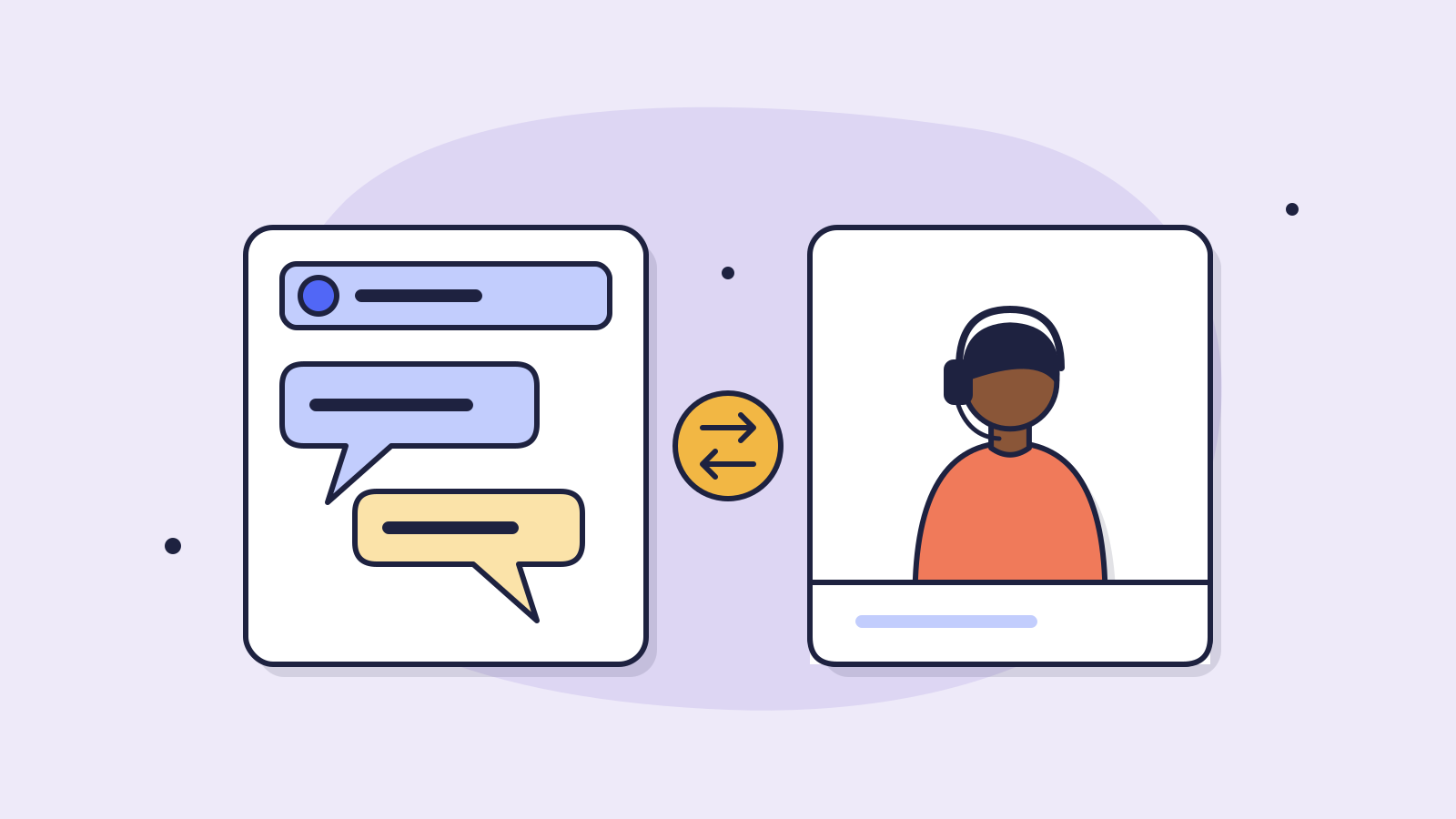
AI chatbot or live chat with a human? The question is wrong. In practice none of the Chatwize customers run only one of the two, they use both, with a clear division of labour. Below: what that division looks like, when to choose which channel, and the mistakes we see most often.
The real difference, in one sentence per channel
An AI chatbot replies instantly, scales broadly, learns from your content, and misses nuance on complex or emotional questions. A human reasons along, senses what a customer actually wants, scales poorly, and costs more per question. The difference isn't a quality spectrum, it's a division of labour.
Compared on six dimensions
| Dimension | AI chatbot | Live chat (human) |
|---|---|---|
| Response speed | Instant | Wait time 1-15 min |
| Cost per question | €0.01–€0.20 | €2–€8 (hourly × time) |
| Scalability | Many conversations at once | 1-on-1, ~5 max parallel |
| Empathy / nuance | Limited | Strong |
| Works 24/7 | Yes | Only during shifts |
| Learns from content | Yes, automatically | Training time required |
6 moments where AI wins
- FAQ questions covered by your knowledge base (hours, returns, delivery times).
- Product advice that lands on a product page, bot returns a direct link.
- Outside office hours (35-65% of traffic in our cases).
- Multilingual interaction, a good chatbot recognises and switches languages automatically.
- Repetitive work that otherwise burns out your best agent.
- Research phase: customers browsing without firm purchase intent.
5 moments where the human wins
- Emotionally charged complaints, you don't want an automated reply to an unhappy customer.
- Irreversible actions (cancellation, refund, contract change).
- Strategic B2B conversations where relationship and context matter.
- Specific financial, medical or legal questions, the bot may inform, not advise.
- When the customer explicitly says “I want to speak to someone”, hand off immediately, no mini-flow.
The hybrid split that works in practice
At Bestel-verf, Onlineborenkopen, Innovi and Hypadvies we see the same split: the bot covers evenings, weekends and the broad middle of questions. The team stays in live chat during the day for the complex 10-15%. Both channels share the same widget, the customer doesn't pick explicitly, the system routes based on question type.
Rule of thumb
Plan for 60-80% of questions resolved by the bot, 10-20% handed off with context, and 5-10% routed straight to a human from the first message (a visible “speak to someone” button on the welcome screen).
What a bot must hand over to a human
The minimum handoff payload
- The full conversation up to that point
- What the customer said they want to achieve
- Which product pages or articles were already shown
- Timestamp, so SLAs can be measured
- Reason for escalation (intent, complaint, explicit request)
A bot that only forwards “name, email, question” gives your team a form, no context. That's the difference between a chatbot your support team appreciates and one they want to switch off every month.
Frequently asked questions about chatbot vs live chat
- Does an AI chatbot replace live chat entirely?
- No. In every Chatwize implementation human agents stay active, for complaints, complex B2B questions and anything emotionally charged. The bot covers the broad middle (60-80%) and the hours when no team is online.
- When does an AI bot escalate to a human?
- On four triggers: the customer asks for a human, intent falls outside the bot's domain (complaint, refund), the bot signals low confidence on its answer, or the customer asks the same topic twice without accepting an answer.
- What if my customer doesn't want a bot?
- Always show a visible “speak to someone” button on the welcome screen. No hidden escalation behind a mini-flow, that frustrates people and lifts churn. Customers who want a human get one fast.
- Does this work for B2B?
- Yes, with a different split. B2B leans more on live chat (40-60%) because conversations are more complex and relationship-driven. The bot is most useful for lead qualification, FAQ and after-hours research.
- How do you measure success of a hybrid setup?
- Three metrics: share of conversations fully resolved by the bot (target 60-80%), average time-to-human on escalation (target under 5 minutes during working hours), and customer satisfaction on closed conversations (target equal or better than pre-launch).
- Can I start with only a chatbot and add live chat later?
- Yes. Many SMBs start that way. Tip: from day one, set up a fallback that lets customers leave details on escalation, so you don't make day-one promises you can't yet keep.
Read next
Customer service5 min read
After hours: the silent majority of customer questions
35-65% of customer questions arrive outside office hours, at every client. Who's asking, what they want, and why this is the moment for automation.
Customer service9 min read
8 implementations, 5 patterns: what AI chatbots really do
Eight customers, eight sectors, one striking outcome: the same five patterns keep returning. What they are, and how to use them in your rollout.
Ready to make this happen for your team?
Book a short demo and we'll show how Chatwize fits your customer questions, channels and processes.